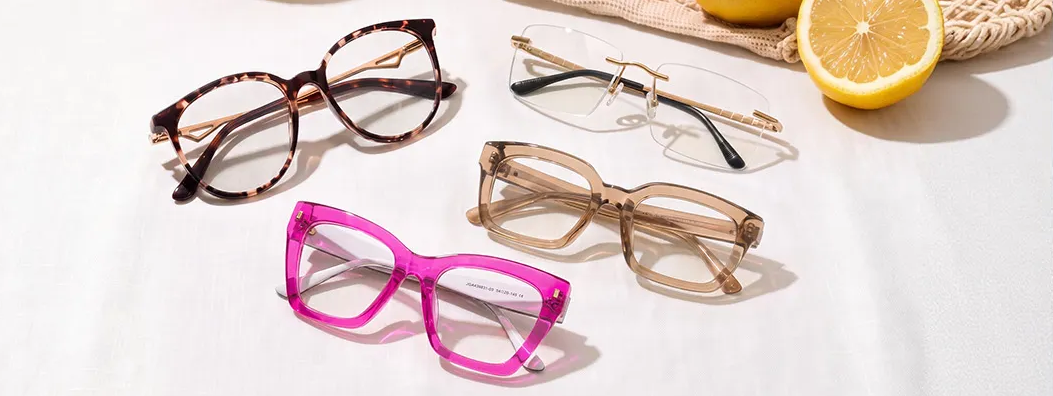










Glasses should fit snugly and sit level, without pinching, sliding or creating painful pressure. The bridge should be comfortable, the temples should hug the sides of your head without squeezing, and the frame should stay in place with normal movement. Your lenses should never touch your eyelashes or your cheeks. The right fit helps you wear your glasses comfortably and see clearly and consistently through the lens.
Key Takeaways
- Glasses should not be tight, but secure.
- Depending on the bridge fit, you can get slipping, nose pressure and high or low frame sit.
- Total frame width is more important than judging fit from lens width alone.
- Temple arms should gently curve around the head and not dig into the temples or behind the ears.
- When you look down, smile and move naturally the frame should remain reasonably stable.
- Minor fit problems can be adjusted, but fundamental size mismatches usually require a different frame.
The 7-Point Glasses Fit Checklist
A good fit for your glasses is the result of several points of contact working together. Rather than asking if a frame just “feels big” or “feels small,” check eye position, bridge fit, frame width, temples, ears, facial clearance and stability separately.
There is one little difference that can be played with. Often, when several issues occur at once, it means the frame shape or size is not the best fit.
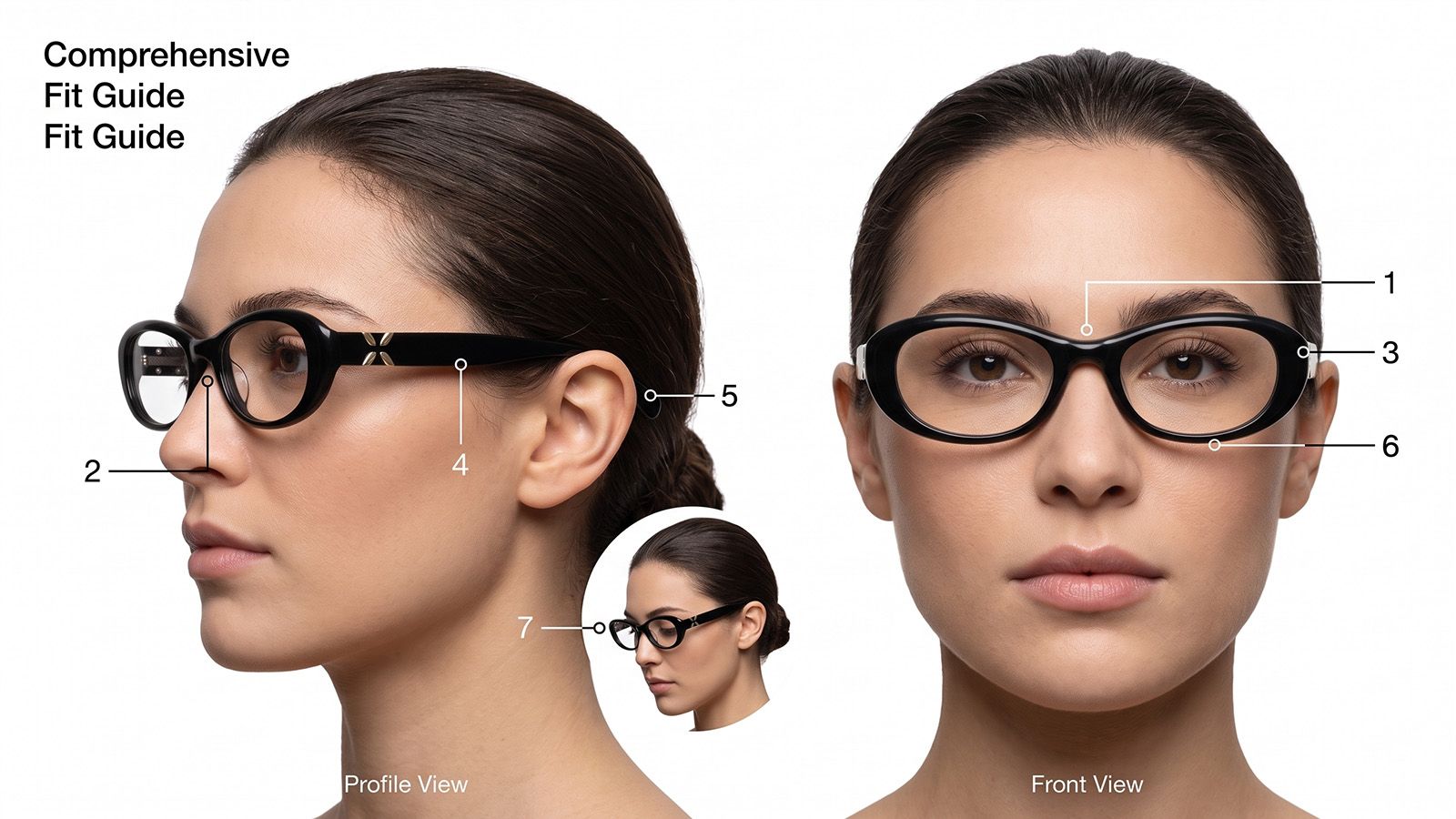
1. Eye Position and Brow Level
To start, look directly forward in a mirror.
Your eyes should be pretty well centered in the lenses, not right up against one side. Not every frame needs to be perfectly visually centered, but an obviously odd eye position can be a tip-off that the frame is too big or too small or not sitting right on your bridge.
Next, observe the relation of the top of the frame to your brows.
There is no hard and fast rule that glasses have to sit directly below your eyebrows. Of course the spacing will vary with different brow shapes and different frame styles. More important is how the frame looks on your face and whether it remains in a consistent position.
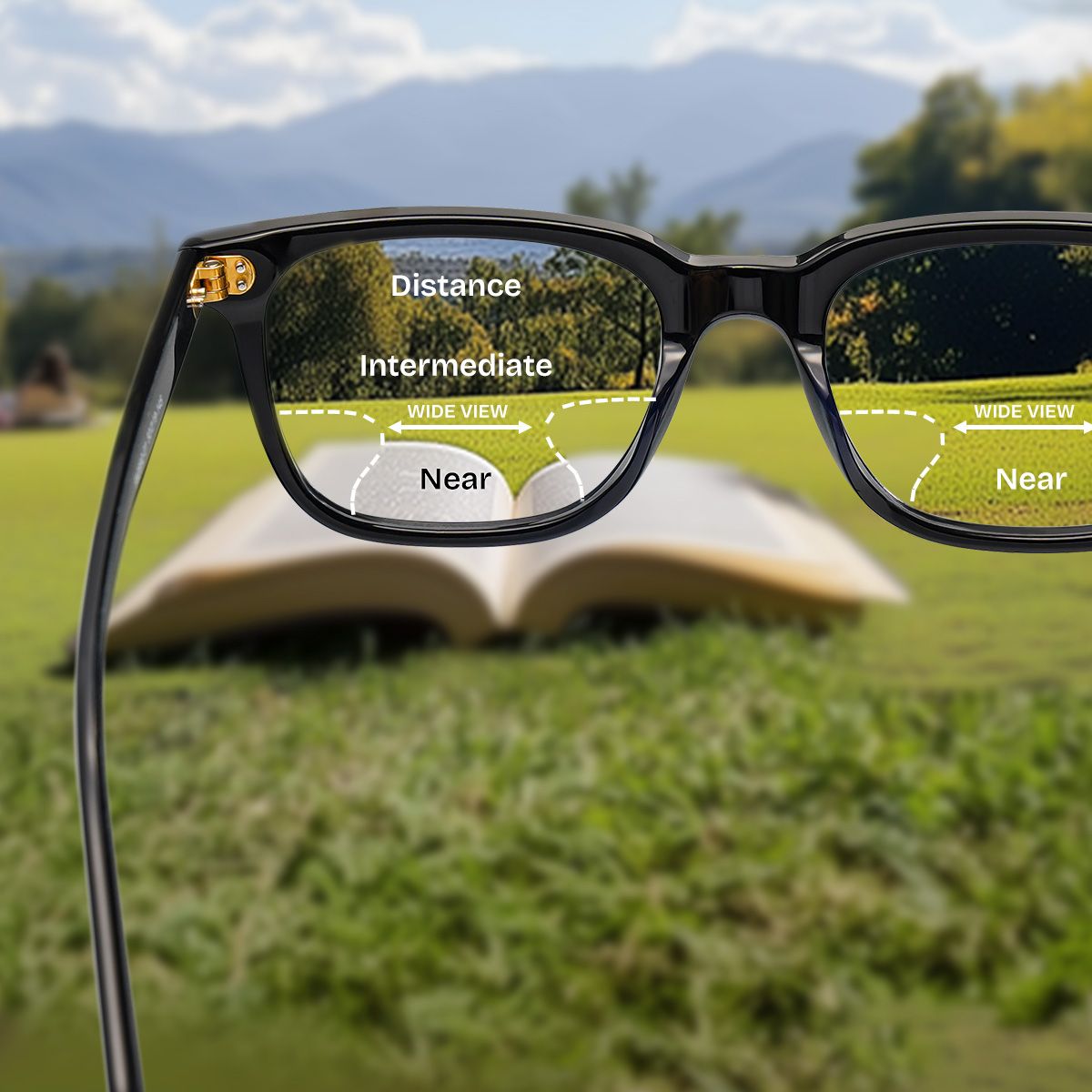
For prescription glasses, especially those that are more dependent on fitting position, the relationship between your eyes and the lenses also affects visual performance. Progressive lenses, for example, have different viewing zones throughout the lens instead of one uniform power everyplace.
2. Bridge Contact & Nose Pressure
The bridge should hold the frame without painful pressure or the glasses sliding constantly.
3 things to look for:
- Will the frame stay in place without constant pushing?
- Is the pressure dispersed? Or is it concentrated in one small area?
- Does the height of the frame keep the lenses from touching your cheeks and lashes?
A wide bridge can make the glasses sit too low or slide off more easily. An uneven contact may also be caused by an incorrect bridge shape.
But a bridge that’s too tight may create concentrated pressure or visible marks.
Temporary light marks don’t necessarily mean a frame is bad, especially after long wear. But repeated soreness or pain on pressure means the fit needs attention.
3. Total Temple Width
One of the easiest ways to tell if a frame is fundamentally too wide or too narrow is to look at the overall width.
Look at the temples from the front, and slightly from above.
In a perfect world, the frame would rest across your face without pinching in or extending far beyond your head's sides.
You can push the temples right out after coming off the hinges, but you may end up with a frame too narrow for your head.
If the frame sticks out far from your face and feels loose even with the temples in the right place, it might be too wide.
So it can be misleading to focus on just one number, like the width of the lens. Bridge width, frame construction, lens shape and the position of the temples all contribute to the overall fit.
If you’re shopping online, check the dimensions of a new frame against a pair you already wear comfortably. How to measure your glasses frame size, ZEELOOL explains how to use these measurements as a reference.
4. Temple Arms Along the Sides of the Head
The temples should be running over the sides of your head, not digging into them.
A good temple fit should feel comfortable, secure and, after a few minutes, easy to forget about.
Warning signs are:
- Noticeable pressure in both temples
- Temples visibly bowed out
- A feeling of tightness that builds through the day
- Headaches always in the spots where the frame touches you
Conversely, temples that are just grazing the sides of your head can result in a loose or unstable fit.
Glasses can sometimes rub around the nose, ears or temples, and minor frame adjustments by an optician can often help with fit-related discomfort, Cleveland Clinic notes.
5. Fit Behind Ears
The ends of the temples should comfortably sit around or behind your ears and help keep the glasses in place.
Should not be creating a hard pressure point.
If you develop soreness behind the ears after a little while there are a few things that you might want to check. Maybe the temples are too tight, maybe the bend isn’t in the right place for your ear, maybe the whole frame is pulling forward because something else isn’t fitting right.
Fit problems go hand in hand. For example, if your glasses keep slipping down your nose, you might crank the temples really tight, solving one problem but creating another.
Therefore, the whole frame should be considered, not just one contact point in isolation.
6. Removal of Cheeks and Eyelashes
Your lenses should be so clear that your eyelashes don't hit them over and over, and that your cheeks don't constantly push the frame up.
Look in the mirror and smile naturally.
Depending on your facial structure and frame style, a little movement is possible. But if each smile significantly raises the frame or pushes it out of position, the frame depth or bridge shape may not be right.
If your eyelashes are constantly touching the lenses, this is another test of whether the frame is too close to your eyes.
That doesn’t always mean the whole frame is the wrong size. The distance between your eyes and the lenses can also be affected by the placement of the nose-pad or the style of the bridge.
7. Stability When Looking Down and Moving Naturally
Finally, test the frame in movement.
Look down at your phone. Just turn your head normally . Walk about the room. Talk and smile.
Your glasses don’t have to feel glued to your face but should remain reasonably close to their normal wearing position.
If they slide a lot every time you look down, the bridge, width, temple fit or some combination of these may need looking at.
If you're constantly pushing your glasses back up, see our guide on how to keep glasses from slipping down your nose.
7-Point Fit at a Glance
| Check Point | Good Fit | May Be Too Tight | May Be Too Loose |
|---|---|---|---|
| Eye position | Eyes naturally settle in the lenses | — | Frame too large may cause eyes to look oddly positioned |
| Bridge | Solid and comfy | Pinching or concentrated pressure on the nose. | Too low to slide or sit on |
| Frame width | In relation to face width | Temples flare out from hinges | Face extends noticeably beyond frame |
| Temples | Light, safe contact | Temples pressure | Little side contact or feel unsteady |
| Behind ears | Comfortable support | Gentle or stabbing pressure | Temples are not very stable. |
| Cheeks/lashes | Adequate clearance | Frame might be too tight | Frame may contact cheeks if oversized or sits low |
| Movement | Natural small movement only | If too much tension, may rigidly keep frame | The teeth are moving or shifting frequently |
This table is a guide, not a diagnosis. Sometimes a single sign does not identify the cause of a fit problem.
A 5-Minute Fit Test You Can Do at Home
Most basic frame-fit problems can be evaluated in about five minutes with a mirror and a pair of glasses that you already know fit well.
Minute 1: Verify the Front view
Look ahead.
Request:
- Is the frame square?
- Are your eyes pretty centered in the lenses?
- Is one side significantly higher than the other?
- Does the frame appear much wider or narrower than your face?
Don't just care about making the style look pretty. See how the frame actually sits.
Minute 2: Check the Side View
Turn to the side and look at the temples.
And they should naturally come toward your ears, not pushed out dramatically or pulled away from your head.
Make sure that the glasses are sitting too low on your nose or too close to your eyes.
Minute 3: Look Down and Move
Put your head down as if you were reading a message on your phone.
The frame should remain fairly stable.
Then slowly turn your head side to side. This is not a “shake test,” normal movement is sufficient.
Minute 4: Smile & Talk
Smile naturally.
Check to see if your cheeks push the frame up dramatically.
Talk for a few seconds and see if the glasses slowly slide down your nose.
Minute 5: Compare With a Good Fit
If you already have a pair of glasses that fit you well, make a comparison:
- Width total
- Width and height of the lens
- Width of bridge
- Length of temples
- Height of the frame
- Lenses distance from your eyes
You don't have to match each measurement exactly. The fit is determined by the frame design.
That's all, the comparison gives you a useful personal baseline.
How Tight Should Glasses Be?
Your glasses should be tight enough to stay on but loose enough that you don’t feel pressure all the time at your temples, nose or behind your ears.
“Tighter” does not necessarily mean “better fit.”
A good fitting frame is not made by strong pressure on one point, but by balanced contact over a few areas.
At the bridge
You want to feel supported, not pinched.
If you’re always having to push your glasses up, then the bridge is probably too loose, too wide or just the wrong shape for your nose.
But the tradeoff for solving the slipping problem is a big nose pressure.
At the temples
The temple pieces should just lightly follow the sides of your head.
If they leave deep pressure marks, bow out dramatically or you have a constant feeling of squeezing, the frame may be too narrow or need adjusting.
Behind the ears
The temple bend should help stabilize the frame without digging into the skin.
Sometimes pain behind the ears can be caused by a little bit of a misalignment. It can also be caused by a frame that is too narrow overall or a frame that is always sliding forward.
Mild discomfort related to fit may occur at the nose, ears, or temples and frame adjustment may help, the Cleveland Clinic says.
The useful rule is: Your specs should stay put because they fit, not because they pinch.
How Do I Know If Frames Are Too Wide or Narrow?
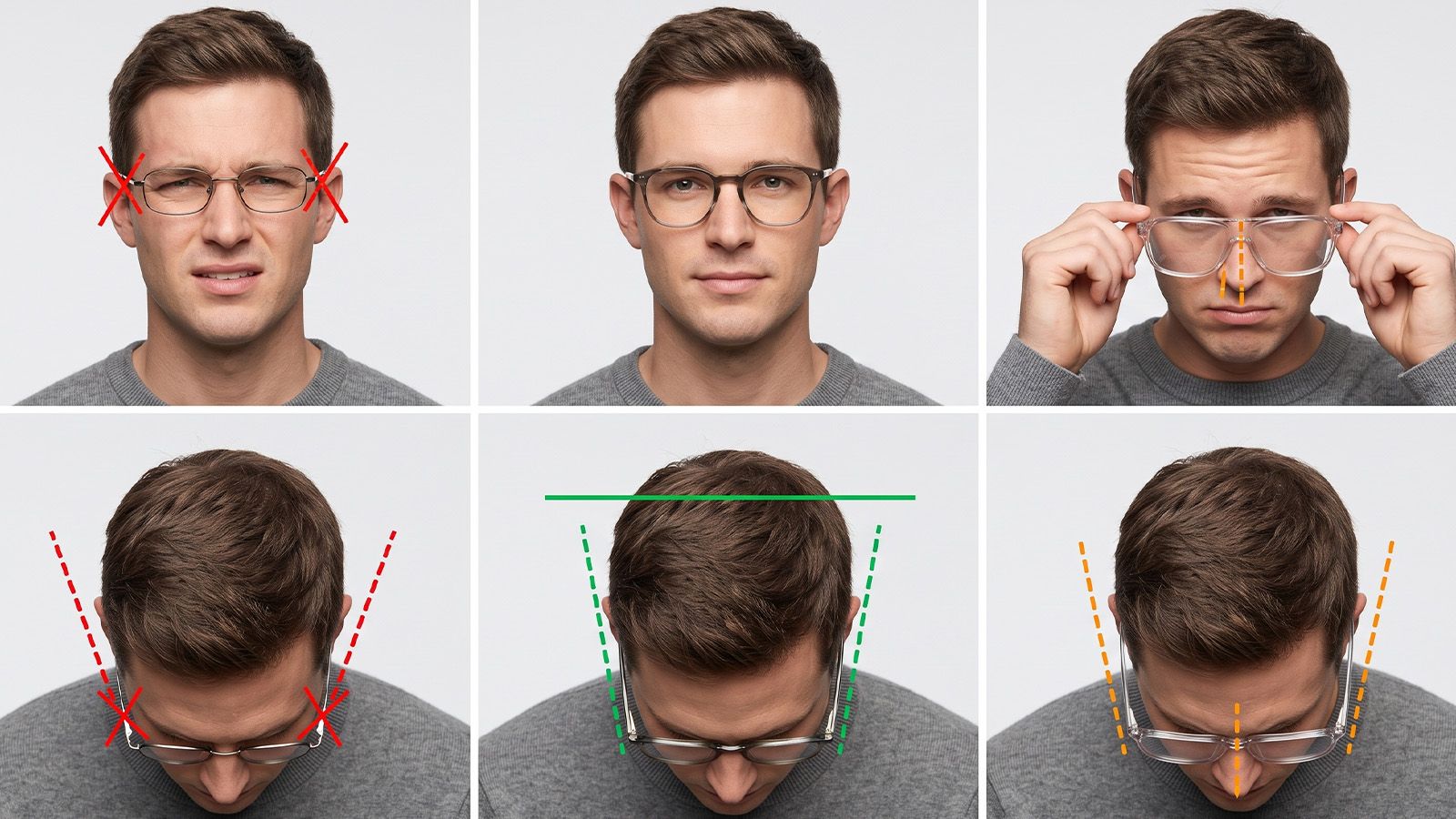
Frames can be too narrow if they pinch the temples, push the temple arms out, or apply constant pressure to the sides. If frames extend a lot beyond your face, slip a lot or feel unstable even when bridge and temples are positioned normally, they may be too wide.
But always width should be judged as part of the overall fit.
Even if the overall width is right, the glasses can slip if the bridge is too wide. And ear pain isn’t necessarily a sign that the frame is too narrow; it might be that the temple bend just needs adjustment.
So it is better to look for patterns of fit problems, rather than try to diagnose frame size from one symptom.
What Common Fit Problems Usually Mean
| What You Notice | Possible Fit Factor | What to Consider |
|---|---|---|
| Glasses are always slipping down | Bridge too wide, frame too big, temples too loose or frame balance | Recheck bridge, temple fit and width all together |
| Temples feel tight | The frame might be too narrow or the temples need adjusting. | Compare overall width with a pair comfortable |
| Heavy pressure on the nose. | The bridge shape or the position of the nose-pads may be incorrect for you | Check for point pressure |
| Ear Pain Behind | Temple bend or temple length or overall frame tension | Professional adjustment might help |
| Frame smacks cheeks | Frame may be too low or lens depth/bridge design not suited to your face | Check bridge location, frame height lashes hit lenses |
| Eyelashes hit lenses | Might be too close to eye Frame | Check nose-pad or bridge placement |
| Higher sitting on one side | Frame may need adjusting/Facial asymmetry may affect fit | Have alignment checked professionally, notice |
| Frame shifts with every move | Overall fit may be too big | Wide temples together check and bridge |
Those are possible explanations, not diagnoses. More than one part of the frame can produce the same symptom.
Can the Frame Be Adjusted, or Is It the Wrong Size?
Some fit problems with glasses can be adjusted slightly , others are related to the underlying geometry of the frame and are better addressed by choosing another size or shape .
Problems which may be adjustable
An optician may be able to make small changes to the frame material and construction depending on the following:
- Nose-pad position
- Angle of temple
- Bend behind the ears
- Slight frame tilt
- Slight slackness at the temples
- Regular chassis alignment
Opticians are trained to fit and adjust eyeglass frames and if glasses don’t quite feel right, they can make adjustments or repairs, Cleveland Clinic explains.
Problems that may suggest the wrong frame
Adjustment has its limits.
When a different frame may be the better solution:
- The width of the frame is far too narrow or broad
- The shape of the bridge never suits your nose
- The lenses are way too high or low for the intended fit
- Your cheeks are repeatedly pressed against the depth or shape of the frame
- The lens height or frame geometry is not suitable for your lens needs
- Fix one pressure point, you create another somewhere else
Do not make large bends or aggressive adjustments yourself, especially if you have prescription lenses installed. Different materials react differently to heat and pressure, and forcing a frame can damage it or affect the mounting of the lens.
Fit Considerations for Different Needs
Low-Bridge Fitting
If your glasses are always sliding down your nose, sitting too low, touching your cheeks or sitting too close to your eyelashes, the problem may not be the overall size, but the design of the bridge.
Frames with low-bridge-fit have a different proportion of bridge to nose-contact to better suit some facial structures.
What matters is not whether your nose is “high” or “low” in any objective sense. The only thing that matters is if the frame sits comfortably and stably on your face.
When comparing frames, look at where the bridge actually sits as opposed to just the printed bridge width number.
Wide Frames or Extended-Fit
If you find that regular frames always pinch your temples or force the temple arms out, a wider frame may be better balanced.
Don’t just buy the biggest frame you can find.
Find a frame with a total width that follows your head naturally but still provides a secure bridge fit.
A frame can be wide on the lenses, but if the bridge is wrong it can still feel off. Likewise, a comfortable bridge won’t make up for a frame that’s far too narrow across the temples.
Strong Prescriptions & Progressive Lenses
Sometimes frame fit can be especially important when lens design is more about placement.
Progressive lenses have different viewing zones for distance, intermediate and near vision. Due to the optical design, the relationship of your eye, the position of the frame and the fitting of the lens is more critical than with a simple fashion frame.
The frame size and shape can also affect the final thickness, weight and comfort of the lens, especially for stronger prescriptions.
And that is not to say that there is one best frame for all strong or progressive prescriptions. Prescription details, facial measurements, frame geometry and individual visual needs all count.
If you are unsure whether a specific frame will work with your prescription or progressive lens design, professional fitting advice is more helpful than simply choosing by style.
Conclusion
Comfort and Clear Vision Should Go Hand in Hand
A frame can look good and be the wrong fit.
When worn normally, the best-fitting glasses are almost invisible, stay in place, avoid painful pressure, and keep the lenses always in front of your eyes.
If your glasses are constantly sliding, pinching or hurting, the first thing to do is find out where the problem is. There are different things that can cause temple pressure, ear discomfort and bridge pressure.
Small fitting problems can be adjusted. Usually a different frame is needed if the width, bridge shape or frame geometry is fundamentally wrong.
And if it’s not just about physical comfort—if you have persistent blur, double vision, unusual headaches, or new changes in vision—don’t assume the frame is the only reason. An eye care professional can also check if your vision or prescription needs an update. Cleveland Clinic recommends that if you have new vision symptoms, you see an optometrist or ophthalmologist rather than an optician for diagnosis.
Looking for your next set of frames? Explore the ZEELOOL Choose Eyeglasses Guide or browse ZEELOOL eyeglasses to compare shapes, sizes and styles.
FAQs
Are your glasses touching your cheeks?
A frame doesn't need to be completely still when you smile but generally your cheeks shouldn't be constantly pushing the glasses up or changing their position much. Sometimes frequent cheek contact can be related to bridge position, frame depth or overall frame shape. If it happens over normal wear, consider a different bridge or frame design.
Why do glasses slide down?
Glasses can slide for a number of reasons including a bridge that is too wide or badly matched to your nose, a frame that is too large, loose temples or a frame whose weight is not well balanced on your face. It also makes slippage more obvious if there’s oil or moisture on the skin. There are several things that can cause this. Check the bridge, the overall width and the temples together, instead of automatically tightening one area.
Can I fix my glasses on my own?
Very small, low-risk changes like cleaning the frame, or checking for a loose visible screw, are one thing, redesigning the frame itself is a different thing. Avoid aggressive temple bending, avoid heating plastic frames or pushing nose pads into a new position without knowing how the material will react. An optician is trained in fitting frames and can help to avoid damage to the frame or lenses.