









Glasses that stay up without touching the cheeks usually have a bridge and nose support that match the wearer, the right shape of lenses that don’t go too far down, a good overall width and stable temples. Low-set frames on the bridge, adjustable nose pieces or shallower lenses may help, but your best choice will depend on your measurements and the geometry of the frame.
Key Takeaways
- Cheek contact is often related to bridge position, lens height, frame tilt and width.
- Simply picking up a frame with nose pieces does not mean the bridge is correct.
- Low Bridge Fit is not about a frame that will fit every face but design elements.
- Check the eyelash contact and cheek contact separately.
- Virtual Try On doesn’t predict movement or pressure points.
Why Do Glasses Touch Your Cheeks
The bridge does not support the glasses, the lenses go too far down, the frame tilts or the temples allow the glasses to slide, which causes the glasses to touch the cheeks. The shape of the lower rim may be contact only when you smile, or contact at rest may mean the frame is already too low.
| Possible cause | What you may notice | What to compare |
|---|---|---|
| Bridge does not match | Repeated sliding or low lens position | Bridge shape and nose support |
| Lens shape is too deep | Lower rim touches during a smile | Lens height and lower-rim contour |
| Frame tilts forward | Bottom rim sits closer to cheeks | Bridge position and temple angle |
| Width is unbalanced | Frame shifts or rests unevenly | Total frame width and hinge position |
| Temples lack stability | Glasses start high then slide | Temple length and bend behind ears |
No facial feature is a defect. The aim is to match the frame structure to the way it rests and moves on your face.
What Frame Features Help With Cheek Clearance
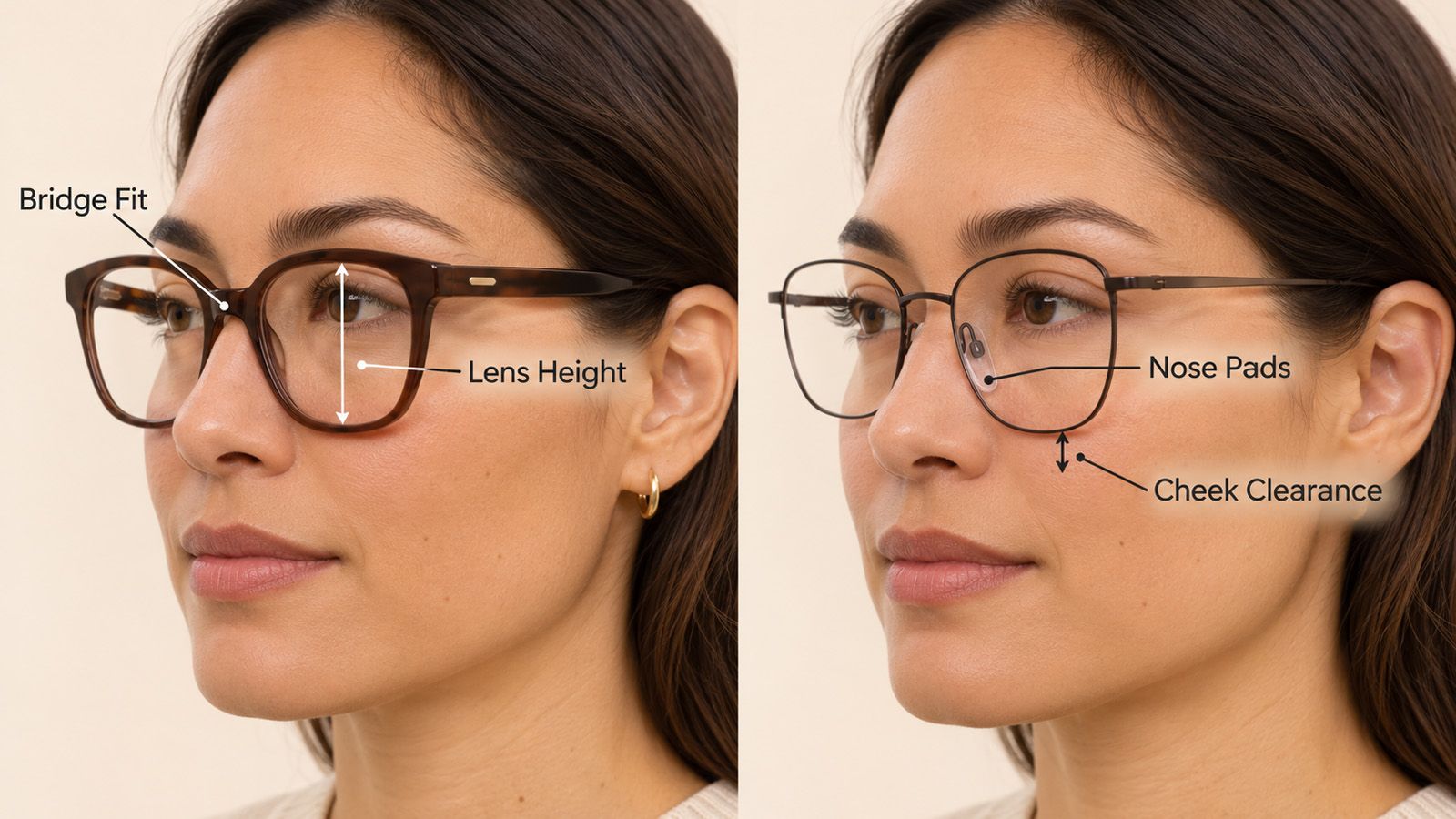
Compare bridge shape, nose-pad support, lens height, tilt, overall width and temple stability together.
Adjustable Nose Pads
Adjustable pads can change where the frame rests and create more space below the lenses. They still need even contact; poor positioning can create pressure. Browse glasses with adjustable nose pads, then compare the full measurements.
Shallower Lens Shapes
A shallower lens or a lower rim that curves away from the cheeks may give more clearance. Don’t rely on a shape name like rectangle or cat eye – check the lens height on the product page.
Stable Temples
Temples that sit evenly and bend in the right spot behind the ears help keep the front from sliding. They should hold the frame and not pinch the head.
Balanced Frame Width
If a frame is too wide, it can move around and settle lower. If the frame is too narrow it can distort the front or put pressure. Compare the total width to a pair that already fits.
Are Low Bridge Fit Glasses a Good Option
Low-bridge-fit glasses are worth comparing if standard frames slide, sit close to the eyelashes or touch the cheeks. They may use raised or differently positioned nose support and temple geometry to improve stability. Anyone who benefits from the design can wear it.
Start with the ZEELOOL Low Bridge Glasses selection, but do not rely on the label alone. Check bridge design, total width, lens height and temple length for each frame. The guide on whether you need low bridge fit offers a more detailed comparison.
Check Eyelash Cheek and Bridge Clearance Separately
Test the frame when you are still, smile and blink. Determine if the lower rim sits on the cheeks, if a smile pushes the frame up, and if the lashes sweep the lenses.
Makeup transfer, repeated fogging or smudges in one area can be helpful clues but they don’t pinpoint the cause on their own. Good cheek clearance does not mean the frame is not too close to the eyelashes and vice versa.
What Can Be Adjusted and What Requires Another Frame
Some minor alignment issues, temple tips and nose pieces can be fixed. An inappropriate bridge, lenses that are too deep, a width that does not match or a structure that cannot be safely altered usually requires another frame.
Do not heat, twist or force frame at home. What can be changed depends on material, hinge design and lens mount. If you are in doubt, ask an optician to check it.
A Pre Order Cheek Clearance Checklist
Measure a comfortable pair, then use the Frame Size Guide to compare bridge width, lens height, total width and temple length. Read product reviews for specific comments about sliding, eyelashes or cheek contact. Use Virtual Try On to compare appearance and proportions, not as proof of physical clearance.
When the glasses arrive, try them on with a neutral expression and also with a smile. As you lower your head and turn it, make sure they remain aligned. Do not wear the glasses if contact causes pain, skin injury or interferes with vision and have them adjusted by a professional.
FAQs
Should glasses touch my cheeks when I smile?
Some face/frame combinations may allow for brief light contact. The cheeks should not lift the frame or constantly smear the lenses or cause discomfort.
Do adjustable nose pads always fix cheek contact?
No. They help only when the frame and bridge geometry allow a suitable adjustment. Lens height, tilt and width still matter.
Can low bridge fit glasses work for anyone?
Yes. Anyone whose frame sits more securely with that design can consider it. Measurements and wearing behavior matter more than a demographic label.
Why do my eyelashes touch the lenses?
The frame might be too close because of bridge position, nose-pad placement or tilt. Check eyelash clearance without regard to cheek clearance. Compare low-bridge-fit and adjustable-nose-pad options. Then check the lens height, width and temple length. The right frame should be held steadily in common motion, without pressing the cheeks or sitting against the eyelashes.