







Summary
Reading glasses correct presbyopia — the age-related loss of near-focus ability that typically begins in the early 40s — using plus-power lenses that compensate for what the eye's natural lens can no longer do independently. Over-the-counter reading glasses work well for people with simple, equal near-vision needs in both eyes. If you have astigmatism, differing corrections for each eye, or need a combination of near and far vision, you’ll need reading glasses with a prescription. Progressive and bifocal lenses are the most practical solution for people who need vision correction at multiple distances because they combine near and distance correction in one pair of glasses. The best option for you depends on your specific prescription, the activities you do each day, and how much flexibility you need in your vision throughout the day.
Introduction
It usually starts gradually. The print on a menu needs better lighting than it used to. Your phone gets held a little further away before the text comes into focus. A book that used to be comfortable to read for an hour now causes eye strain after twenty minutes. These are the early signs of presbyopia—and most people reach a point where some form of reading correction becomes necessary. The question is which type. Over-the-counter reading glasses from a drugstore are the most accessible option, but they are not the right solution for everyone. Understanding what reading glasses actually do, how to choose the right strength, and when a prescription becomes necessary makes the decision significantly clearer.
What Causes Near-Vision Difficulty?
In adults over age 40, near vision problems are almost always caused by presbyopia, the gradual loss of the eye’s ability to change focus between distances as the natural lens stiffens with age.
The eye’s natural lens changes shape to focus on near and distant objects—a process called accommodation. In younger eyes, this happens automatically and quickly. But as the lens ages, it loses its flexibility, and it is more difficult to accommodate, especially for close-up distances. The result is blurry or fatigued near vision that was not present earlier in life.

Presbyopia is distinct from the following:
● Myopia (nearsightedness): Difficulty seeing at distance, caused by the eye being too long rather than lens stiffness
● Hyperopia (farsightedness): Difficulty seeing up close caused by the eye being too short—different from presbyopia, though the symptoms can overlap
● Astigmatism: Blurring at any distance caused by irregular corneal curvature
Reading glasses specifically address presbyopia. If your near-vision difficulty is caused by astigmatism or hyperopia rather than simple presbyopia, reading glasses alone may not solve the problem.
Types of Reading Glasses and Vision Correction Options
Five main options exist for near-vision correction, each suited to different prescription needs and lifestyles.
Reading Glasses Over-the-Counter (OTC)
The most convenient option. Sold without a prescription in standardized plus-power strengths from +0.75 to +4.00 diopters in 0.25 increments. Both lenses are the same power.
Suitable For:
● Adults suffering solely from simple presbyopia who have no significant need for distance vision correction.
● People with the same visual requirements for both eyes.
● People who only need to focus on near vision from time to time—such as reading, checking a cell phone, or handling small objects.
Prescription Reading Glasses
Single vision lenses are made to order based on the results of a clinical eye examination. Each lens is made according to the specific prescription of the corresponding eye and, if necessary, can also correct astigmatism.
Best for:
● People with astigmatism affecting near vision
● Anyone whose eyes need different correction strengths
● People who need stronger near correction than OTC options provide
● Anyone experiencing persistent headaches or eye strain from OTC readers
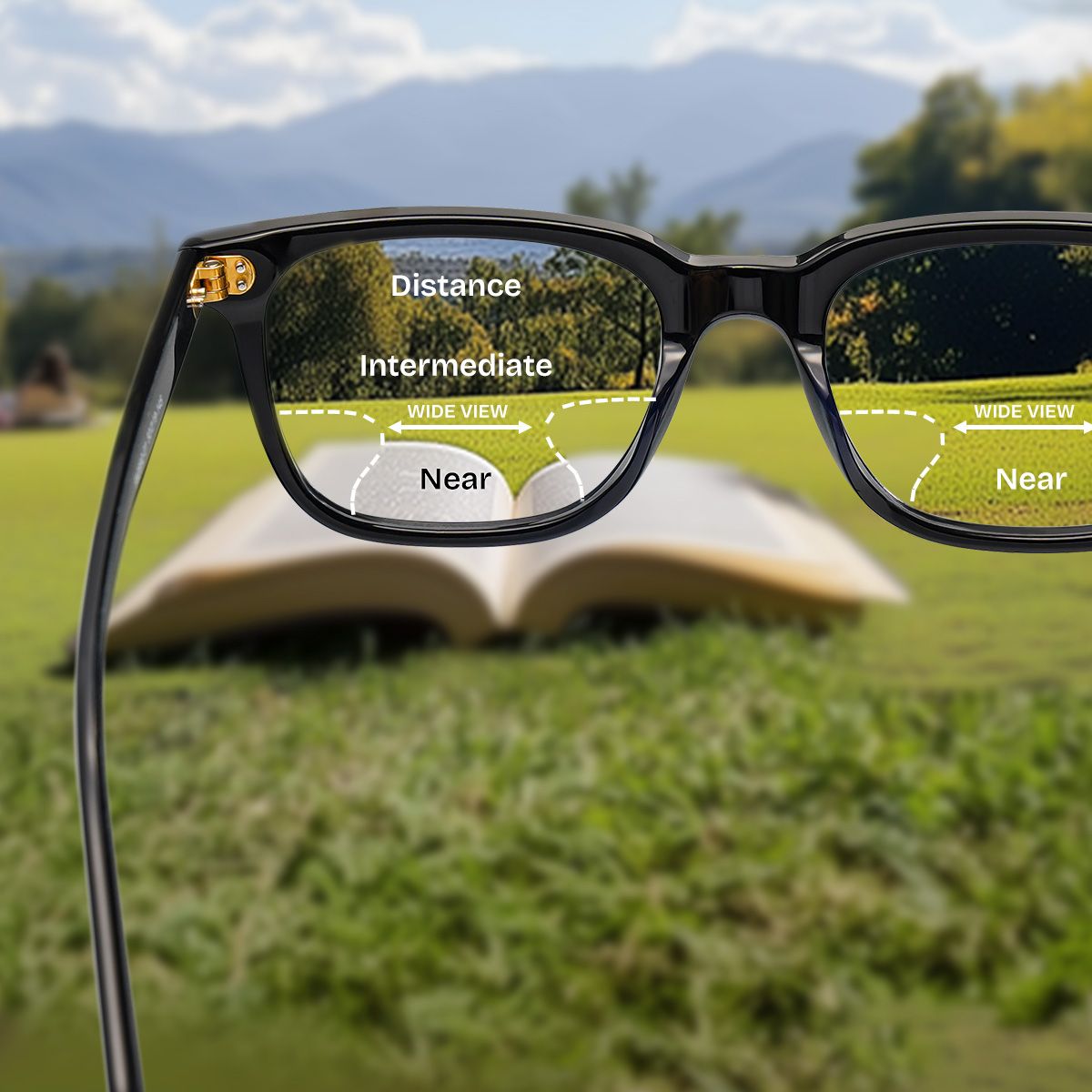
Progressive Lenses
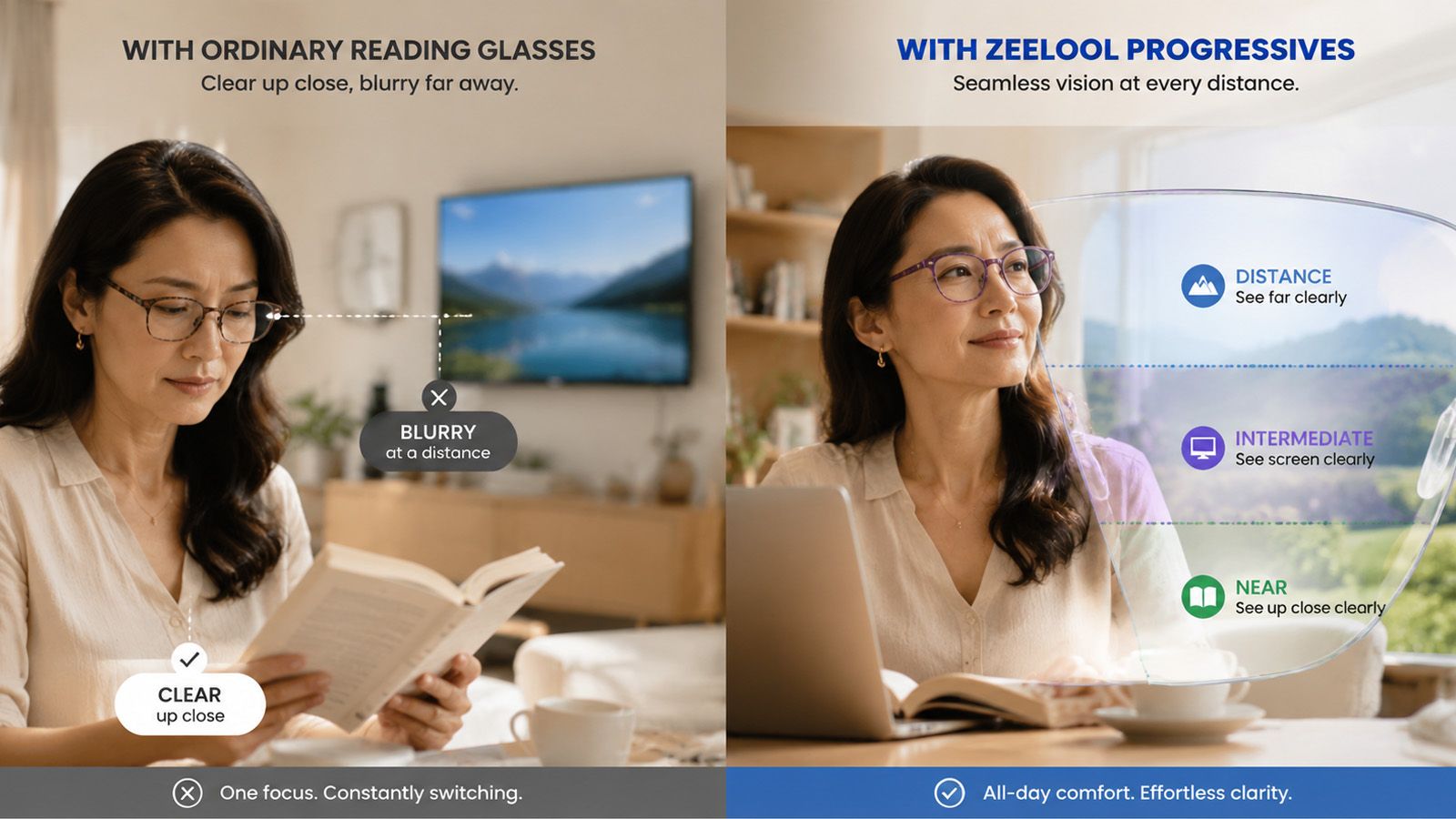
A single progressive lens with three seamless vision zones — distance at the top, intermediate in the middle, and near at the bottom — with no visible dividing line between zones. The prescription includes both a distance correction component and an ADD value for near vision.
Best for:
● Anyone who needs both distance and near correction
● People with significant screen time who benefit from the intermediate zone
● Anyone who wants a single pair that covers all viewing distances
Adjustment period: 1–2 weeks for first-time wearers as the brain learns to use each zone deliberately.
Bifocal Lenses
Two distinct correction zones are separated by a visible horizontal line—distance correction above the line and near correction below. Effective for distance and near but lacks the intermediate zone that progressives provide.
Best for:
● People who mainly switch between distance and near tasks
● Anyone who has difficulty with the progressive adjustment period
● Those who prefer a less expensive multifocal option
Computer Glasses
Single-vision lenses optimized for the intermediate distance of a computer screen, typically 20–26 inches. Different from reading glasses, which are optimized for 14–16 inches. Often include a blue light-blocking coating.
Best for:
● Screen-heavy workers with eye strain at monitor range
● Anyone who has reading glasses that feel too strong at computer range
● Progressive wearers who want a pair for longer screen time
OTC Reading Glasses vs. Prescription Reading Glasses
The key question for most people starting with reading glasses is whether OTC readers will work or whether a prescription is necessary.
| Factor | OTC Reading Glasses | Prescription Reading Glasses |
| Customization | Same power both lenses | Different power each eye |
| Astigmatism correction | None | Full CYL and AXIS correction |
| Power range | +0.75 to +4.00 | Unlimited, precise to 0.25 |
| Cost | $10–$30 typical | From $25.95 at ZEELOOL |
| Availability | No prescription needed | Requires licensed eye exam |
| Best for | Simple, equal, near-needs | Complex or asymmetric prescription |
OTC reading glasses will work if
● Both eyes need similar correction
● There is no significant astigmatism
● Standard strengths in 0.25 steps solve the problem comfortably
● A recent eye exam found no need for distance correction
A prescription is needed if:
● Your eyes need different strengths of correction
● Astigmatism is affecting near vision
● OTC readers cause ongoing headaches or visual imbalances.
● You need distance correction in the same pair
How to Pick the Right Reading Glasses Strength
The right OTC reading glasses strength is the lowest power that makes standard-sized text clear and comfortable at your normal reading distance of 14–16 inches.
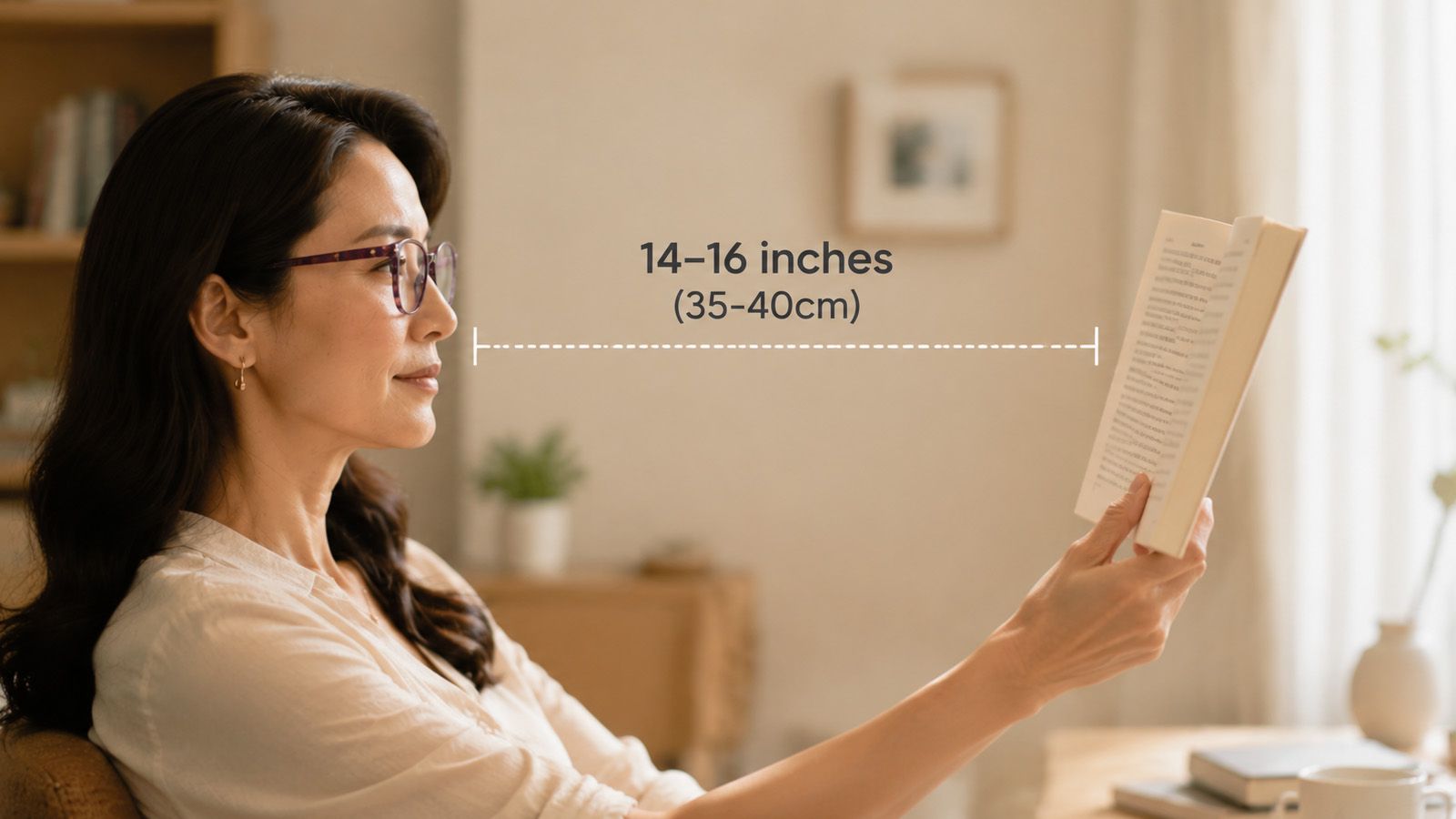
A practical way at home:
1. Start at the lowest strength you have—usually +1.00.
2. Hold a book or your phone at your normal reading distance
3. Try each strength in 0.25 increments—+1.00, +1.25, +1.50, etc. 4. Choose the lowest strength that gives clear, comfortable text without strain
Common strength ranges by age as a starting reference:
| Age Range | Typical Starting Strength |
| Early 40s | +1.00 to +1.25 |
| Mid 40s | +1.25 to +1.50 |
| Late 40s to early 50s | +1.50 to +2.00 |
| Mid 50s | +2.00 to +2.50 |
| 60s and beyond | +2.50 to +3.50 |
These are reference points only; individual variation is significant. The most common mistake is choosing a strength that is too strong. Text may appear clear at close range, but looking up causes dizziness or difficulty refocusing. The right strength will feel natural to you at your normal reading distance, without having to move your head or body.
An eye exam is the most accurate way to determine your exact reading prescription—especially if OTC options haven’t been effective.
Do You Need Prescription Glasses or Reading Glasses?
Reading glasses are for near-vision problems. Prescription glasses are for any refractive error, including nearsightedness, farsightedness, astigmatism, or combinations of these, with exact precision customized for each eye.
The distinction matters because these two types of correction are not interchangeable:
You likely need reading glasses if:
● Your distance vision is clear and unchanged
● You are over 40 and struggling primarily with close-up tasks
● Both eyes are affected approximately equally
● OTC readers at a comfortable strength resolve the problem without causing headaches
You likely need prescription glasses if the following are true:
● Your distance vision is also affected—blurry road signs, faces across a room
● OTC reading glasses cause headaches, visual imbalance, or persistent eye strain
● Your eyes need different correction strengths
● An eye exam identifies astigmatism or a significant refractive error
You likely need progressive or bifocal lenses if
● You need correction at both distance and near
● Your prescription includes both a distance SPH value and an ADD value
● You currently carry and switch between distance glasses and reading glasses throughout the day
Signs You Need to See an Eye Doctor
OTC reading glasses are appropriate for self-selection in straightforward cases.
Visit a licensed optometrist if you experience:
● Headaches that linger after changing to a new pair of reading glasses
● Visual imbalance — one eye appears clearer than the other
● Blurriness that does not resolve with any OTC strength
● Distortion or double vision at any distance
● Difficulty that goes beyond reading to screens and intermediate distances
● Any sudden change in vision—this deserves immediate clinical attention regardless of other factors. Annual eye exams are recommended for adults over 40 even if there are no obvious symptoms, as presbyopia progresses gradually and prescription needs change over time.
How to Order Reading Glasses Online
If you’re in need of OTC or prescription reading glasses, ordering online is easy with the right information.
For OTC reading glasses:
● Use the at-home method above to determine your desired strength
● Measure your pupillary distance, or the space between your pupils in millimeters, for proper lens centering Most PD measuring tools require a credit card to use as a size reference and work well with a front-facing camera.
● Pick a frame style that works with your face shape and fits within your daily context
For prescription reading glasses:
● Get a current prescription from a licensed optometrist, including SPH, CYL, AXIS, ADD if applicable, and PD
● Enter all values at checkout—ZEELOOL's prescription entry guide walks through each field clearly
● Check that lens height is sufficient for your lens type—progressive lenses require at least 28–30 mm of vertical lens space.
ZEELOOL offers reading glasses across a range of OTC strengths and prescription options, with frames starting from $7 and a free AR virtual try-on on every product page. All prescription reading glasses—single-vision near, progressive, and bifocal—are available with prescription lenses, and the full selection is accessible with fast delivery across the US.
Caring for Reading Glasses
Reading glasses tend to go on and off more frequently than full-time prescription glasses, which makes them more susceptible to certain types of damage.
Most common sources of reading glasses' damage:
● Setting them face-down on surfaces—scratches lenses
● Carrying them loose in a bag without a case—bends temples and scratches lenses
● Cleaning with clothing, paper towels, or tissues—micro-scratches lens coatings over time
● Leaving them in hot cars warps acetate and plastic frames
Basic care routine:
● Store in a protective case when not in use
● Clean with a microfiber cloth after rinsing with water to remove surface dust
● Use lens cleaning solution for stubborn smudges
● Tighten hinge screws periodically with a small eyeglass screwdriver
Conclusion
Reading glasses are the most accessible entry point into vision correction for most adults—simple, inexpensive, and effective for straightforward near-vision needs. Understanding what they do and do not correct helps you decide whether OTC readers will serve your needs or whether a prescription is necessary. For anyone who needs vision correction at multiple distances, progressive lenses represent the most practical long-term solution despite the adjustment period they require. The right choice is the one that covers your actual vision needs clearly and comfortably — and for most people, that becomes clearer with a single visit to an optometrist who can measure what your eyes specifically require.
FAQ
What are reading glasses, and how do they work?
Reading glasses use plus-power lenses to compensate for presbyopia—the age-related loss of the eye's ability to focus on close objects. The lenses add the focusing power that the eye's natural lens can no longer provide efficiently for near tasks. Over-the-counter versions come in standardized strengths from +0.75 to +4.00 and use the same power in both lenses. The version of the prescription is tailored specifically for each eye and can correct for astigmatism and unequal vision needs.
How do I know what strength reading glasses I need?
Start with the lowest available strength — typically +1.00 — and work upward in 0.25 increments until standard text is clear and comfortable at 14–16 inches. Choose the lowest strength that works without causing dizziness when you look up. As a general reference, most people in their early 40s start around +1.00 to +1.25, with needs increasing through the 50s. An eye exam provides the most accurate determination.
Do I need prescription reading glasses, or will OTC readers work?
OTC reading glasses are most effective for individuals with uncomplicated, equal near-vision needs in both eyes and no significant astigmatism. If your eyes need different powers of correction, if you have astigmatism that impacts near vision, or if OTC readers cause you persistent headaches or visual imbalance, you’ll need prescription reading glasses. If OTC readers at varying strengths don’t make you feel comfortable, a comprehensive eye exam is the most reliable next step.
What is the difference between reading glasses and progressive lenses?
Reading glasses only correct near vision and are not suitable for distance tasks. Progressive lenses combine distance, intermediate, and near correction in one seamless lens. Progressive lenses are appropriate when both distance and near correction are needed for everyday use—they remove the need to switch between separate distance and reading pairs throughout the day.
Can I use reading glasses for computer work?
Reading glasses designed for 14–16 inches might strain your eyes at a typical computer screen distance of 20–26 inches. If you have eye fatigue specifically at screen distance, computer glasses or a progressive lens with an intermediate zone can help you work more comfortably on screen-heavy tasks. Some people find their standard reading strength works adequately at screen distance—it depends on individual prescription and screen positioning.
Are reading glasses bad for your eyes?
No — wearing reading glasses appropriate for your needs does not damage your eyes or accelerate vision deterioration. The concern that glasses weaken vision is a persistent myth with no clinical basis. Using the wrong strength—particularly too strong—causes eye strain and headaches during use but causes no lasting damage. Presbyopia progresses naturally with age regardless of whether or not reading glasses are worn.