









Summary
Choosing the right type depends on your specific prescription needs, lifestyle, and how much you want to manage separate pairs. Most people who need both distance and near correction find progressive lenses the most practical long-term solution, despite the adjustment period they require.
Introduction
At some point in their 40s, many people who have worn glasses for distance their whole lives notice a new problem: their glasses no longer work for reading. Or someone with previously perfect vision finds themselves holding their phone at arm's length. Or a routine eye exam produces a prescription with both a distance component and an ADD value they have never seen before. Vision correction becomes more layered as we age—and understanding the different types of glasses available makes navigating those layers significantly less confusing.
What Are Distance Glasses?
Distance glasses correct nearsightedness (myopia)—the inability to see clearly at far ranges—by using minus-power lenses that diverge light before it reaches the eye.
Nearsighted people can see things up close but have trouble seeing things far away: street signs, faces across a room, and boards in a classroom. Minus lenses (a negative SPH value on your prescription) fix that by changing the focal point of incoming light onto the retina instead of in front of it.
Distance glasses are for things where you need to see far away, like driving, watching TV, playing sports, or being in a new place. You wouldn't normally wear them for close-up reading unless you have a bifocal or progressive prescription.
Who Needs Distance Glasses:
● Myopia (nearsightedness) — SPH values with a minus sign
● Anyone who has a significant minus SPH value in either eye
● People whose uncorrected distance vision makes it difficult to perform daily activities

What Are Reading Glasses?
Reading glasses use plus-power lenses to help correct for presbyopia, the age-related loss of the eye’s ability to focus up close, which typically begins in the early to mid-40s.
As we age, the natural lens in the eye becomes less flexible, and it becomes harder and harder to change the focus of the eye to near objects. Plus power lenses (a positive ADD number or a positive SPH number for hyperopic eyes) give the additional focusing power that the eye can no longer provide on its own.
Reading glasses are for near work, like reading books and screens, working with small objects, and any activity that requires sustained near focus. They are not for distance work and should not be worn while driving.
Who needs reading glasses?
● Adults over 40 who have trouble focusing on near objects
● People over 40 who have presbyopia and good distance vision
● People with mild farsightedness (+SPH) who have trouble with near vision
OTC reading glasses from +0.75 to +4.00 are appropriate for people with equal, simple near-vision needs in both eyes. People who have astigmatism, much different corrections in each eye, or much stronger correction needs will need prescription reading glasses.
What Are Progressive Lenses?
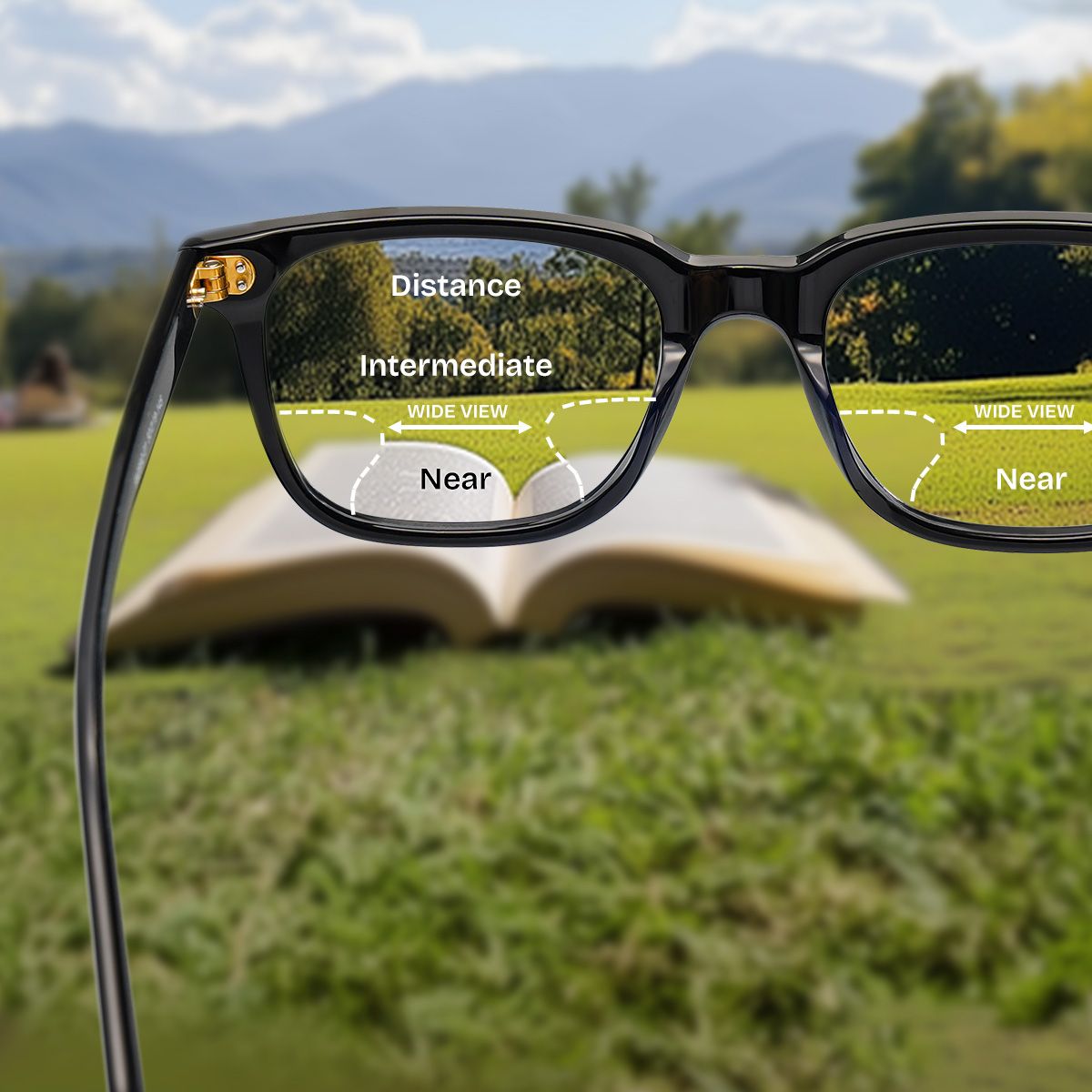
Progressive lenses provide seamless vision correction across three zones—distance at the top, intermediate in the middle, and near at the bottom—in a single lens without a visible dividing line.
Progressive lenses are the modern solution for people who need both distance and near correction, eliminating the need to switch between two pairs. The prescription includes both a distance component (SPH, CYL, AXIS) and an ADD value that determines the additional near-vision power in the lower portion of the lens.
How the zones work:
| Zone | Location in Lens | Used For |
| Distance | Upper portion | Driving, watching TV, outdoor activities |
| Intermediate | Middle portion | Computer screens, dashboard, music stands |
| Near | Lower portion | Reading, phones, close detail work |
The transition between zones is gradual and seamless—which is both the advantage over bifocals and the source of the adjustment period progressive wearers experience. Learning to use the correct zone requires moving the head rather than just the eyes, which becomes automatic within 1–2 weeks for most people.
Progressive lenses require adequate frame height—at least 28–30 mm of vertical lens space to accommodate all three zones comfortably. Very small or narrow frames compress the zones and make progressives difficult to use effectively.
Bifocals vs. Progressives: Key Differences
Bifocals and progressives both correct distance and near vision in a single lens—the primary difference is the visible line that separates the zones in bifocals.
| Factor | Bifocals | Progressive Lenses |
| Zone divider | Visible horizontal line | Seamless, invisible transition |
| Intermediate vision | Not included | Included in middle zone |
| Adjustment period | Minimal | 1–2 weeks |
| Appearance | Line visible to others | No visible line |
| Cost | Generally lower | Generally higher |
| Best for | Simple distance + near needs | Distance, intermediate, and near needs |
Bifocals are a reliable, lower-cost option for people who primarily switch between distance and near tasks without much intermediate work. Progressives are more practical for people with significant screen time, who benefit from the intermediate zone for computer use.
How to Know Which Type You Need
Your prescription values and daily activities together determine which vision correction type is most appropriate.
You likely need distance glasses only if
● Your prescription shows a minus SPH value and no ADD value
● Your near vision is comfortable and unchanged
● You are under 40 with no signs of presbyopia
You likely need reading glasses only if:
● Your distance vision is normal or near-normal
● You are over 40 and struggle primarily with close-up tasks
● An eye exam confirms no distance correction need
You likely need progressive or bifocal lenses if
● Your prescription includes both a distance SPH value and an ADD value
● You need clear vision at multiple distances throughout the day
● You currently own and use both distance and reading glasses separately
Questions to ask yourself:
● Do you drive regularly? You have to do a distance or progressive correction.
● Spend a lot of time at the computer? Progressive lenses with an intermediate zone are more comfortable than bifocals.
● Do you often switch between reading and distance tasks? One progressive pair is easier than two separate pairs.
● Is your primary issue reading only? OTC or prescription reading glasses may be sufficient.
Can You Use One Pair for Everything?
For people who need both distance and near correction, progressive lenses are the closest thing to a single-pair solution. They cover all three viewing distances in one frame and eliminate the inconvenience of switching glasses throughout the day.
The situations where multiple pairs still make sense:
● Dedicated reading glasses for extended sessions: Some progressive wearers prefer a single-vision near pair for long reading sessions because the near zone of a progressive lens is smaller than a full reading lens.
● Prescription sunglasses for driving: Separate prescription sunglasses with distance correction are more comfortable for extended outdoor driving than transitioning to the distance zone of progressives.

● Backup pairs: Having a second pair of distance glasses avoids being without correction if your primary pair breaks.
ZEELOOL offers single-vision distance glasses, reading glasses, and progressive lens options with frames starting from $7. All lens types are available with prescription, and progressive lenses are compatible with any frame showing a minimum lens height of 28mm on the product page.
Conclusion
Distance glasses, reading glasses, and progressive lenses each serve a distinct purpose in vision correction. Understanding which type corresponds to your specific prescription and daily vision needs removes the guesswork from choosing — and prevents the common mistake of using the wrong correction for the wrong task. Most people's needs evolve over time as presbyopia develops alongside existing distance correction, making the transition to progressive lenses a natural next step for anyone who has worn glasses since childhood and is now noticing changes in their near vision. The right pair makes all three viewing distances comfortable, reduces the strain of frequent focal adjustments, and eliminates the inconvenience of carrying multiple pairs.
FAQ
What is the difference between distance and reading glasses?
Distance glasses correct nearsightedness—blurry far-vision—using minus-power lenses. Reading glasses correct presbyopia, or the inability to focus up close, with plus-power lenses. They address different vision problems and are not interchangeable. Many people over 40 need both types of correction, either as separate pairs or combined in progressive or bifocal lenses.
Do I need distance glasses or reading glasses?
If your primary difficulty is seeing things far away—road signs, faces across a room—you likely need distance glasses. If your primary difficulty is close-up tasks like reading small print, you likely need reading glasses. If both distances are affected, progressive or bifocal lenses address both in a single pair.
What are progressive lenses, and are they worth it?
Progressive lenses are designed to correct vision at all distances in one lens—distance, intermediate, and near. They eliminate the need for separate pairs and are particularly beneficial for people with significant screen time who need the intermediate zone for computer use. The adjustment period of 1–2 weeks is the main trade-off—most people find it worthwhile for the convenience of a single pair.
Can I drive with reading glasses?
No. Reading glasses are optimized for close-up distances of 14–16 inches and do not provide adequate distance correction for driving. Driving with reading glasses that include plus-power lenses can actually blur distance vision and is unsafe. Use distance glasses or the distance zone of progressive lenses while driving.
How do I know if I need progressive lenses?
If your prescription includes both a distance SPH value and an ADD value—the additional near-vision power—progressive lenses are the most practical solution. They combine both corrections in a single pair and include the intermediate zone for screen use. Your optometrist will typically recommend progressives when both distance and near correction are needed in everyday life.