











Key Factors and Conclusion
Eye floaters are shadows cast by vitreous clots, which are familiar with age.
Flashes are bright lights from the retina pulling on the retina.
Sudden-onset floaters, persistent flashes, or a vision curtain indicate an emergency.
Sometimes it happens when you are just relaxing. You look at the sky, or a bright wall, or even your laptop screen, and you notice strange little shapes drifting across your vision. They look like tiny dots, thin lines, or something like hair floating in the air. When you try to look at them properly, they move away. It can feel confusing and distracting.
Most people experience this at some point in their lives. Very often, it is nothing serious at all. Many adults notice these changes more as they get older, and they learn to live with them. But the problem is, not all eye changes should be ignored. Sometimes, these signs may indicate a deeper issue within the eye.
This article explains the difference between floaters and flashes. You will learn what they are, why they happen, and when they become dangerous. Most importantly, you will know when it is time to stop waiting and seek emergency help to protect your eyesight.
What Are Eye Floaters?
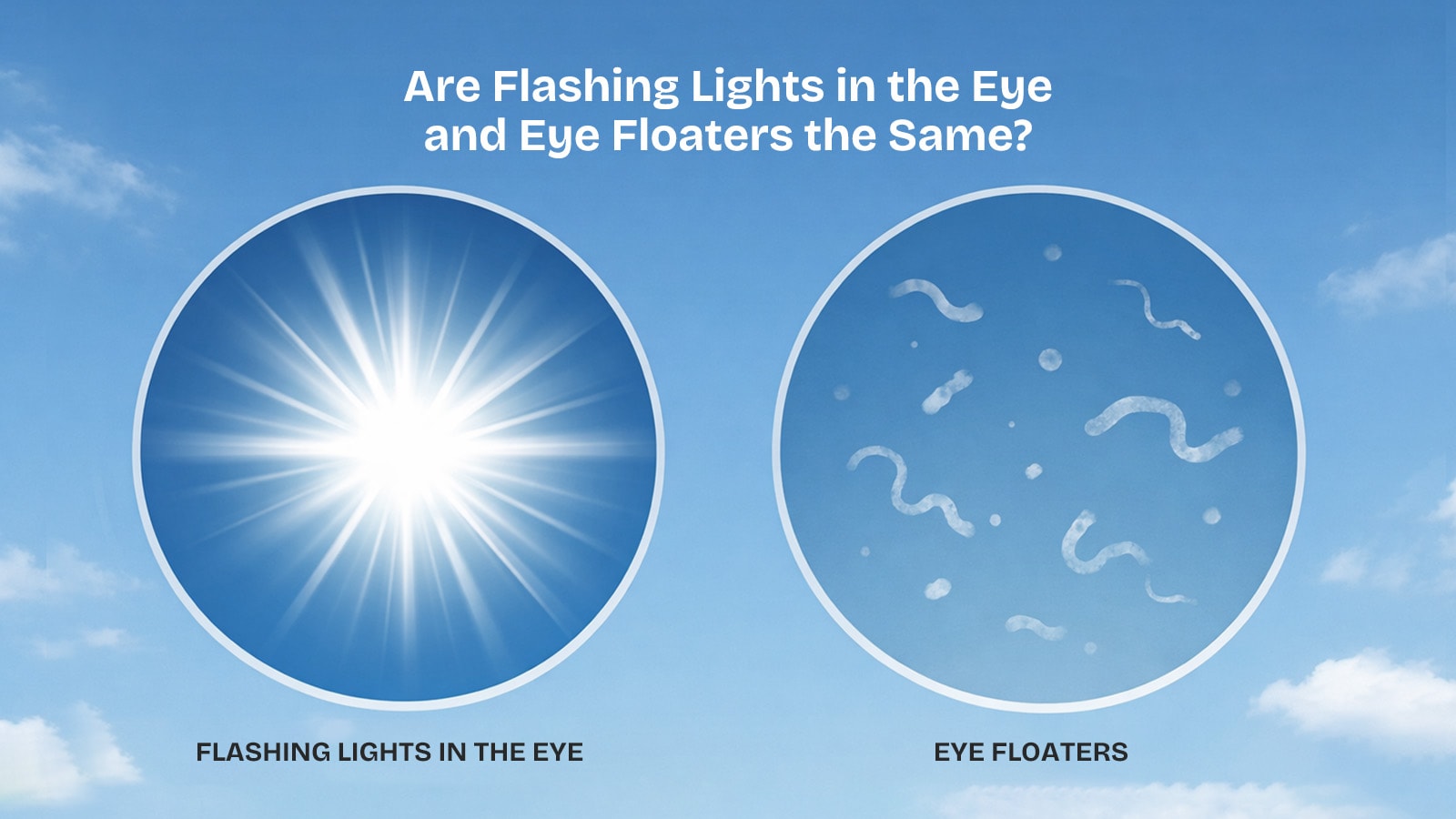
Eye floaters are small shapes that seem to move across your vision. They are not really floating outside your eye; they are inside the eye itself. Many people see them as black dots, gray spots, thin strings, or cloudy shadows. Some people describe them as tiny worms or spider webs.
The vitreous humor is a clear, jelly-like substance inside the eye. This jelly fills most of the eye and keeps it round. When we are younger, this jelly is firm and clear. Over time, it changes. It becomes more watery and starts to shrink. This is a normal aging process.
When the jelly shrinks, tiny fibers inside it can stick together. These form small clumps. You do not see the clumps directly. What you see are their shadows falling on the retina at the back of your eye. That is why floaters appear blurry and never seem to stay still.
Floaters usually move when your eyes move and then slowly drift away. Many people notice them more when looking at bright backgrounds like the sky or a white screen.
Age is a major factor in floaters, especially after 50. Near-sighted people are also more likely to notice them earlier. Some people think long screen time causes eye floaters, but there is little evidence to support this. Learn more about this in detail in our Can Eye Strain Cause Floaters blog.

What Are Eye Flashes?
Eye flashes are different from floaters. They look very different. Flashes appear as sudden bright lights in your vision. Many people describe them as lightning, sparks, or quick camera flashes, often at the side of the eye.
Flashes occur when something touches or pulls on the retina. As the vitreous jelly shrinks, it can rub or tug on the retina. The retina then sends signals to the brain. The brain interprets this signal as light, even though there is no light around. This is often related to posterior vitreous detachment.
It is important not to confuse flashes with ocular migraines. Ocular migraines usually cause zigzag shapes or shimmering lines that last for several minutes and then disappear. Flashes caused by the eye jelly pulling on the retina are very quick and can happen again and again.
Many people notice flashes more in dark rooms or when moving their eyes fast, like turning their head suddenly at night.

Key Differences: How to Tell Them Apart
Here is a simple way to tell the difference between floaters and flashes:
- Floaters look dark, gray, or shadow-like
- Flashes look bright, sharp, and electric
- Floaters move slowly and drift around
- Flashes appear suddenly and disappear fast
- Floaters can stay for years
- Flashes come and go in short moments
Both can be normal, but changes matter the most.
Eye Flags: When to Seek Emergency Eye Care
This is the part you should remember clearly. While floaters and flashes are often normal, a sudden change is not. In some cases, these symptoms are signs of retinal detachment.
Retinal detachment happens when the retina starts to pull away from the back of the eye. It is like wallpaper peeling off a wet wall. When this happens, the retina cannot work properly. If treatment is delayed, it can cause permanent vision loss within 24 to 48 hours.
There are three serious warning signs to watch for:
- Sudden onset: Many new floaters appear all at once, like a shower of dots
- Persistent flashing: Strong flashes that keep coming back
- Curtain effect: A dark shadow or gray curtain moving across the side vision
One dangerous thing is that retinal detachment usually does not cause pain. Do not wait for pain. If you notice these signs together, go to an emergency room or eye specialist immediately. Delaying care can lead to permanent vision loss.
Conclusion
Healthy eyes are essential for both clear vision and everyday comfort. While ZEELOOL is known for fashion-forward frames and vision correction, eye health always comes first.
Regular eye exams, especially dilated exams, are the only way to properly check the retina. A simple vision test is not enough. People with high prescriptions, which ZEELOOL prescription eyeglasses often support, have a higher risk of retinal issues and should be extra careful.
Protecting your eyes from UV rays with proper sunglasses can also help slow aging inside the eye. Knowing the warning signs can truly save your vision. Stay stylish, but always listen to what your eyes are telling you.
FAQ
What is the difference between eye floaters and flashes?
Floaters look like drifting dots, threads, cobwebs, or shadows caused by material inside the vitreous casting an image on the retina. Flashes look like brief sparks, streaks, or lightning and can occur when the vitreous pulls on the retina.
When are floaters and flashes an emergency?
Seek urgent same-day eye care for a sudden shower of new floaters, new or increasing flashes, a dark curtain or shadow, missing side vision, or sudden blur—especially after eye injury or surgery. These can signal a retinal tear or detachment.
Do eye floaters go away on their own?
Many stable floaters become less noticeable as the brain adapts or the material shifts, but they may not physically disappear. A new floater still needs assessment when it appears suddenly, increases quickly, or comes with flashes, a shadow, or vision loss.
Can glasses or eye drops remove floaters and flashes?
Ordinary prescription glasses and over-the-counter drops do not remove vitreous floaters or retinal flashes. Treatment is based on the underlying cause. An urgent dilated eye examination is the correct next step when warning signs are present.