









Key Factors & Conclusion
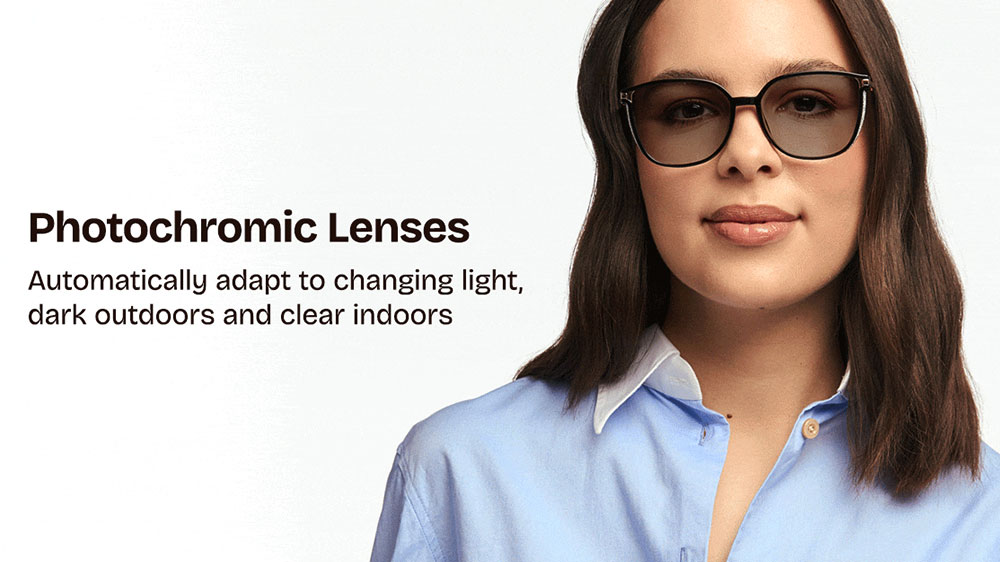
Photochromic lenses provide clear vision indoors and UV protection outdoors.
They darken under sunlight/UV exposure and return to transparency indoors.
Advantages: Convenient, blocks UV rays, reduces glare.
Disadvantages: Slow adjustment speed, poor performance in vehicles, higher cost.
Function by altering lens color through UV-reactive molecules.
Ideal for individuals frequently transitioning between indoor and outdoor environments.
Constructed from durable plastic and customizable to prescription strength.
Easily identifiable: transparent on the inside, dark on the outside.
Do you have a hard time looking for the right balance of indoor and outdoor glasses? Photochromic lenses are just what you need. These lenses will provide clear indoor vision as well as protection from the sun when moving indoors from the outdoors and vice versa. It means that there is no need to carry two pairs of glasses or a pair of glasses and lenses with you.
This article goes further to explain the working of photochromic lenses, their types, advantages and disadvantages, and whom they benefit the best.
What Are Photochromic Lenses?
Yes, these lenses darken whenever irradiated with light, including exposure to UV or sunlight as well. So as long as these two components are absent, such lenses come back to a clear state. Because of the nature of the spectacles, which are considered glasses that transform depending on environment, they are referred to as transition lenses. As photochromic lenses are designed for both outdoors and indoors, they are able to block harmful UV rays. Upon entering the building, the photochromic lenses started to darken.
If you are someone who enjoys wearing prescription glasses and would rather not wear the lenses separately, then photochromic lenses can be a more affordable option for you, as they are capable of modifying two lenses into various forms and can also be designed specifically for certain prescriptions.
Mechanism of Photochromic Lenses Explanation
Photoactive molecules bond chemically with the molecules embedded in the glasses and undergo alteration, which makes these lenses dark when they get exposed to UV radiation. The gray shine indoors and the daylight when outside cause the molecules present in the lens of light-sensitive glasses to darken. Once the UV radiation is removed, the photo molecules transform back into their original shape, which makes the glasses clear once again.
Under the direct sun, a maximum amount of UV light penetrates the lens and makes it dark, as opposed to cloudy weather or sitting in the shade, which does not allow much light to penetrate. One of the most important things to notice is that while in the car, lenses tend to become useless due to photochromic windows blocking the UV radiation, therefore rendering these chromosomes useless. There are two simple yet important distinctions between glasses worn inside cars and outside the car.
Guidance on the Identification Process for Photochromic Lenses
In a nutshell, photochromic lenses can be dismantled into three tone categories: suitable, undesirable, and UV-sensitive.” The black and light transitions along with the movement of a person from either indoors to outdoors portray whether a person is wearing a photochromic lens or not.
Materials & Coating: Plastic with a high melting point is used in the construction of photochromic lenses. Make sure you know if the lenses you bought are photochromic by looking at the product details or by asking the seller.
Visual Evaluation: Photochromic lenses often share the same hue when indoors. If, however, the tint of the lens becomes deeper once you go out, this means that your photochromic lenses are doing their job.

Would photochromic lenses be of interest to you?
If you want to read questions three or four, it gets much attention that centering on whether a person should acquire photochromic lenses or not largely depends on one's tastes and way of living. What follows are some advantages and disadvantages to assist you in making your decisions.

Advantages:
Convenient to use: The convenience of use is that one does not have to carry separate pairs of prescription glasses and sunglasses since one pair can serve both purposes, thus making them ideal for people who frequently go outside.
Provides protection from adverse UV effects: With its incorporation of photochromic lenses, it gives the user a safeguard from the adverse impact of sun rays.
Provision for adjustment: Lenses of this type moderate to changing lighting, taking focus of minimizing the likelihoods of glare, thus increasing the comfort of the user, especially in brightly lit areas or extremes of lighting.
Disadvantages:
Adjustment period: A stage of discomfort may be experienced due to the device's propensity to respond slowly when moving from bright environments to dark or the other way around.
Does not work in a vehicle: As has been mentioned previously, photochromic lenses are unlikely to get dark when one is wearing them in a vehicle, as the car windows prevent some of the UV radiation.
Cost factors: Due to the technology utilized in photochromic lenses, it can be assumed that these are going to cost more as compared to ordinary lenses.
To conclude, photochromic lenses can be ideal for people with an active lifestyle, alternately spending time indoors and outdoors. These also reduce the expense of requiring a separate lens for low-light settings. Nevertheless, if one is often in cars or has to switch light conditions rapidly, these lenses may not be appropriate for such a purpose.