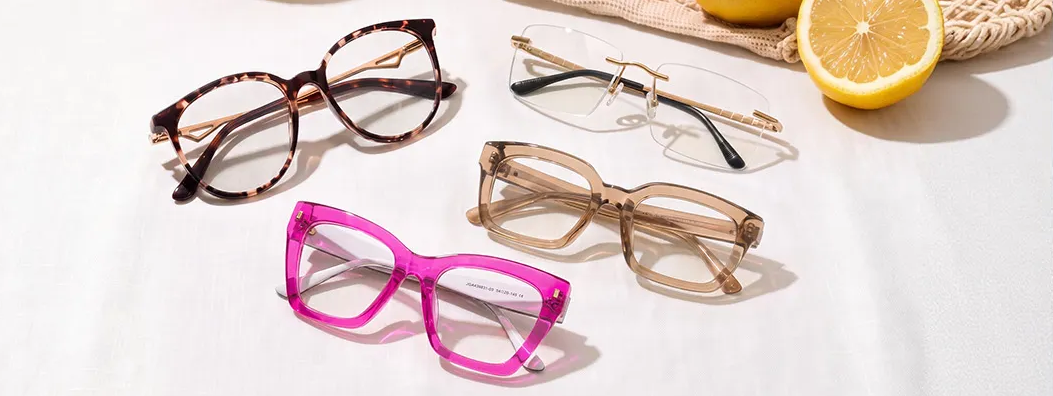








You can choose the corresponding prescription lens type based on your visual correction needs. Here are several common types of prescription lenses for glasses:

Single Vision Lenses
Single vision lenses have the same amount of prescription over the entire lens and are used to correct myopia or hyperopia problems. These lenses are suitable for people with relatively stable prescriptions and do not require additional visual correction.

Bifocal lenses
Bifocal lenses are suitable for those who need both distance and near vision correction. The lenses have two focal points, the upper part of the lens is used for distance vision correction, while the lower part of the lens is used for near vision correction, so they can be used to correct both distance and near vision at the same time. Bifocal lenses are suitable for people who need both distance and near vision correction, such as older people or people who need to see both near and far objects.

Trifocal Lenses
Trifocal lenses are similar to bifocal lenses but have an additional intermediate vision correction area between the distance and near vision fields. They are useful for people who need intermediate distance correction (e.g., computer use).

Progressive Multifocal Lenses
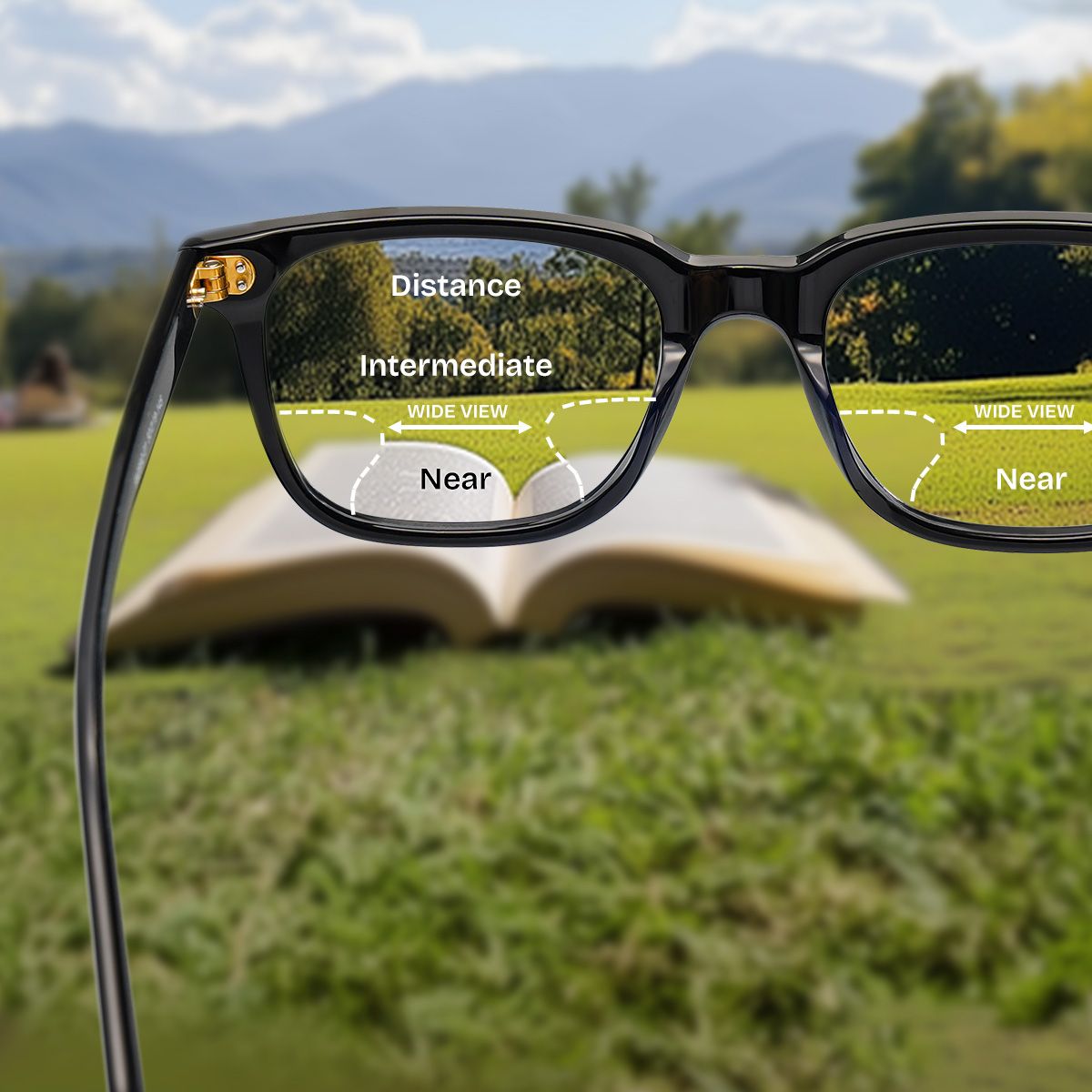
These lenses provide a continuous area of focus with a smooth transition from distance to near vision, which is a better experience than bifocal lenses. Progressive lenses are used when you need to correct both distance and near vision, as well as for age-related presbyopia. They provide a more natural visual transition, so you don't have to change glasses as often.

Reading lenses
Reading lenses are eyeglasses specifically designed to improve near vision in people with presbyopia. Presbyopia is a common age-related condition that affects the eye's ability to focus on close objects. It usually becomes noticeable around the age of 40.

Reading glasses are primarily used to correct presbyopia and help people see clearly at close distances. They provide additional zoom in the lower portion of the lens and are specifically designed for reading, working on a computer, or performing other up-close tasks.
Additionally, reading glasses are available as non-prescription eyewear, without a customized prescription, in order to follow different age-corresponding magnifications, or multiples, ranging from +1.00 to +3.00 diopters in increments of 0.25 or 0.50.
No prescription lenses
No prescription lenses are usually flat and do not change the refraction of light, so they do not provide vision correction; they are not used to correct vision problems such as nearsightedness, farsightedness, or astigmatism but are only used to provide additional eye protection or to improve visual comfort. These lenses can reduce eye fatigue, overexposure, or glare sensitivity and provide additional support for the eyes.
FAQ
What are the main types of prescription lenses for glasses?
The primary types of prescription lenses for eyeglasses are single vision, bifocal, trifocal, progressive multifocal, and reading lenses. Single vision lenses handle one distance—near or far, not both. Bifocals and trifocals split the lens into two or three zones with a visible line between them. Progressives do something similar but without the line, blending smoothly from distance to near. Reading lenses are a simpler option designed purely for close-up work.
What is the difference between single vision and progressive lenses?
Single vision lenses are good at one thing—they correct your distance or near vision, but not both. If you need help seeing at multiple distances, progressive lenses are the more flexible choice. They carry a range of prescriptions from top to bottom, so you can look up to see across a room and look down to read without switching pairs. The trade-off is that progressives take some getting used to, while single vision lenses are straightforward from day one.
What is the difference between bifocal and progressive lenses?
Both correct distance and near vision in a single lens, but they go about it differently. Bifocals have a visible line dividing the two zones—distance on top, near on the bottom. Progressives blend those zones gradually with no line at all, which most people find more natural-looking and comfortable day to day. For everyday wear, progressives tend to be the more popular choice—though anyone switching from bifocals should expect a short adjustment period before the new viewing zones feel natural.
Does ZEELOOL offer bifocal lenses?
No, ZEELOOL doesn’t have bifocal lenses at the moment. If you need correction for distance and near then the option would be progressive lenses, they offer the same dual correction without a line and smoothly transition between zones, which is more comfortable for most wearers for everyday use.